
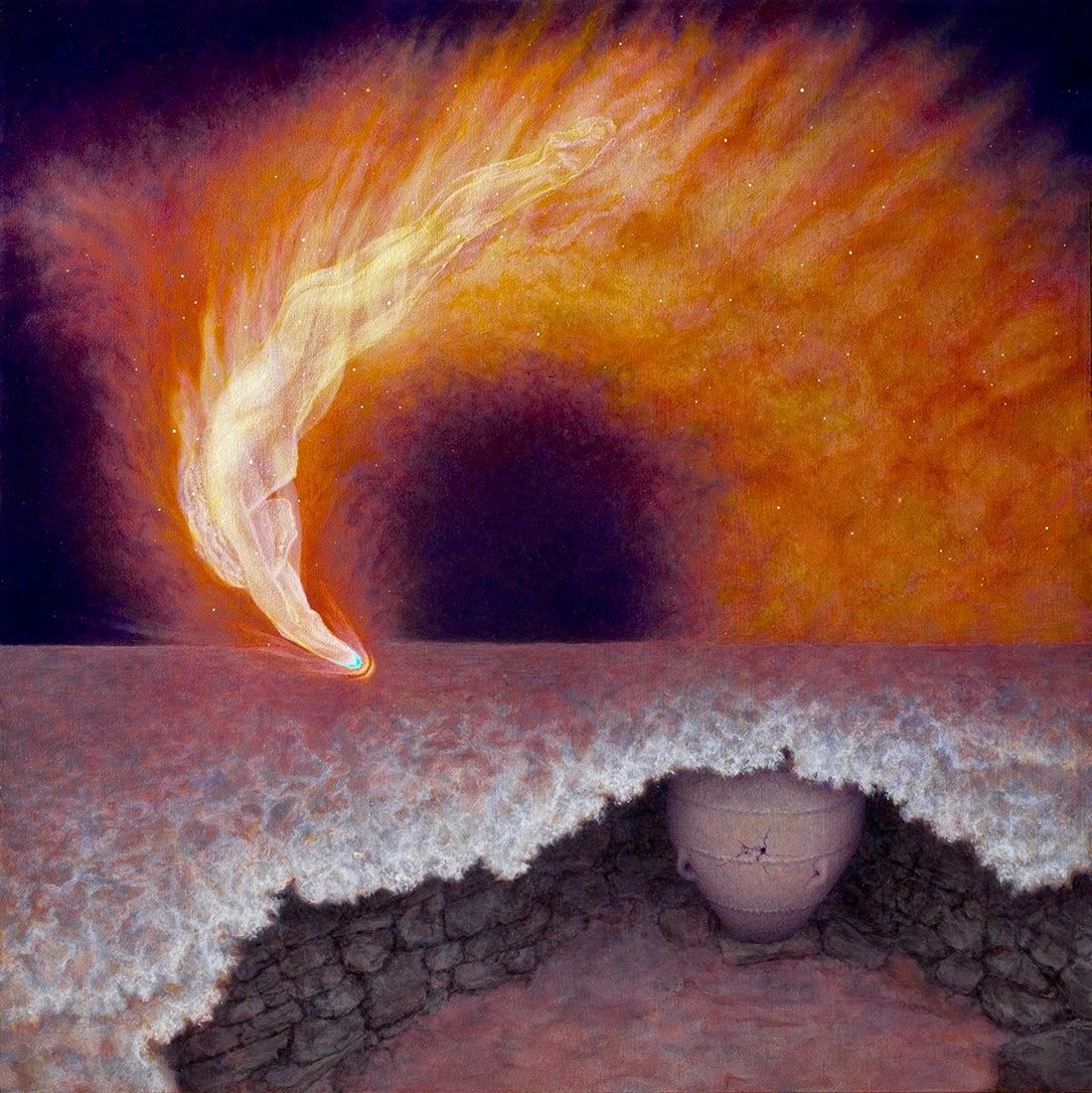
Homage to David Lindsay in An Era in Anddemar
The strange, mystical genius of David Lindsay permeates the unsettling, almost horrendously powerful spiritual vision of his 1920 novel A Voyage to Arcturus, which was greatly admired by C. S. Lewis. Toward the end of his intense spiritual pilgrimage, the main protagonist ascends the inner steps of a windowed Tower, as he becomes increasingly heavier with every step. Throughout the novel, the distant sound of mysterious drumming fades in and out across sometimes unstable landscapes. My own homage to Lindsay inverts his Tower such that four companions - including the Romantic poet John Keats as the young knight Sir Daphen - are led down a tower into the Underworld by the mercurial Trickster Guardian, Terragian . . .
As they began the descent, they saw below them indistinct forms, smelled aromas and heard sounds that hinted at smelted metal, cisterns, sulphur, arsenic and other poisons. Fugitive sparks, nursed in embers prior to their release, darted up the spiralling stairway as if seeking escape. Circling downward, they descended to new depths and gazed from windows in the tower wall into the upper reaches of Underworld. And they saw, flying and drifting outside in a whir of fumes and bluish fire, living flames intertwined with horned and winged beings, while efflorescent forms traced unreadable words of flame in a shimmering haze. The sound of heavy drumming - with a rhythm reminiscent of a heartbeat - echoed in the distance.
Further down, they saw on glowing cliff ledges serpents breathing sulphur, hearing and scenting all the while the volcanic boom and aroma of salt, and the wail of metallic voices heated to a white hot resonance. And they saw raw, embedded diamonds illumined by lightning veiled with smoke. Sir Daphen, enthralled as only a great poet could be, saw visions of distant caves of mottled ore, shiny black porticos, and a diamond balustrade spiralling through rugged loopholes of rock, thence spanning voids and arching over chasms where subterranean streams eroded granite beds.
As they descended further they felt the sense of increasing weight, such that each step became harder to take. Now through the windows they saw less flame and smoke, and more bustling forms. Forges and bellows worked frantically and dark figures scurried here and there, some limping or stunted in growth, others blind and groping, others still carrying torches of flame to illumine their tracks, or being led by animals with quivering snouts and gleaming eyes.
Even further down, tall, cloaked beings were issuing orders and directing work. Half human creatures with shiny carapace armour served as mounts for workers and messengers, while others with segmented mandibles and clicking claws carried materials to and fro, tossed fuel onto belching flames, or served as diggers and crushers of ore.
Led by Terragian, the four followed with the sense of ever increasing weight. Halting awhile, they noticed outside the windows a group of cloaked figures gathered in conference. Among them strode a tall, regal lady at whose side paced a black leopard. A dark cape was flung about her and partially hooded her pale, strong features. Suddenly, while walking away, she halted, wheeled about and glared at Terragian and his companions. Her amber eyes flashed with an icy stare of mingled curiosity and anger.
‘Ainjanneth,’ murmured Terragian with a bizarre blend of lewd desire and innocent amusement.
Quoted text © Maureen B. Roberts, An Era in Anddemar [Vandrassian Press, Australia, 2026]
Artwork © Carol Spicuzza