
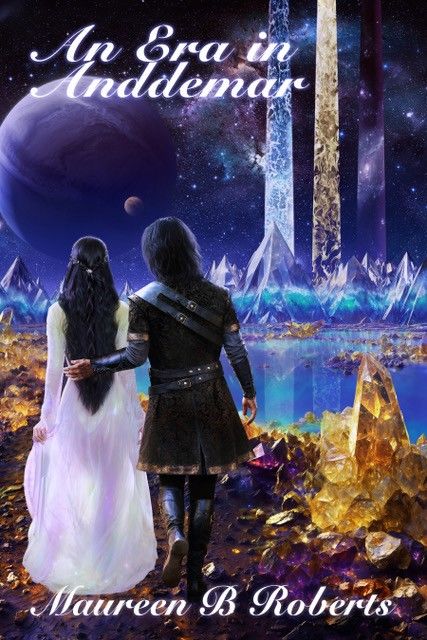
AFTERWORD to An Era in Anddemar
The tale began with what some native cultures recognise and C. G. Jung describes as a ‘big dream’, which decades ago impacted me powerfully. Such dreams arise from the shared depths of the psyche and as such can be important ‘messages’ for the community, or the wider culture, or even the whole world.
In the dream, I was a Goddess dwelling at the heart of a galaxy, surrounded by a throng of children. They needed to cross a plain of broken glass and it was up to me to guide them safely through the danger. To help with that task, I wielded a shamanic staff at the tip of which flames eventually exploded into a rain of red and white rose petals that alighted on the children. An exploration of the meaning of the dream would warrant an essay in itself; I shall merely note here that the experienced identity of ‘the divine’ with (what Jung calls) the ‘self’ - the true centre and circumference of the personality - is very much at the heart of a massive, collective transformation of consciousness now underway through what Jung calls ‘individuation’, as our individual and collective journey toward a conscious wholeness that reconciles all the opposing energies of life.
Following my ‘big dream’, visions, imagination, and follow-up dreams carried forward the paradoxical merging of invention and discovery that gives rise to myth-making, which I would describe as the symbolic dramatisation of key events and transformational changes unfolding in the depths of the World Soul. Throughout this mythic journey, the sense of discovery was always very much at the fore, as compelling characters, ‘high stakes’ themes, unique modes of conflict, and an exquisite love story interwove to become not only a tale that largely wrote itself, but also an imaginal refuge that I - as an intuitive, visionary introvert - could call home.
It was fortunate that some years after penning the first draft of the book, fate led me - while in the throes of an acute spiritual crisis - to the works of Jung, years thereafter to my private practice as a depth and shamanic psychotherapist specialising in helping sufferers of similar crises, which (rightly or wrongly) are often labelled as ‘schizophrenia’. I suggest that fate moved in a ‘fortunate’ way because had my discovery of Jung preceded my original draft the book, the latter would almost certainly have been contaminated with Jungian allegory.
As a mode of story-telling, allegory is far less emotionally impactful than myth because of its reliance on the ‘surface’ tactic of rational persuasion. Myth, on the other hand, by tapping into the irrational power and transcendence of symbol, bypasses the mind to resonate with the boundless depths of the collective soul. Myths, as Joseph Campbell reminds us, are ‘the world’s dreams’ and as such they ‘deal with great human problems.’ As Campbell also understood, the world is always in need of new myths that mirror the evolution of consciousness and our changing relationship to ourselves, to one another, to the Earth, and to the Cosmos as our ultimate origin and home.
As most of us can probably sense, human consciousness and Western culture in general stand at a crossroads. Many of us intuit that we are either on the brink of a ‘great awakening’ - a quantum leap of consciousness that will at best catalyse a new ‘Era’ of oneness and global harmony - or we are headed for unprecedented, possibly irreversible catastrophe.
At rare but crucial intervals throughout history, the world goes through a massive upheaval and an eventual disintegration of its existing paradigms and power structures, as a result of seismic shifts in the ruling dominants, or archetypal patterns and energies arising from what Jung called the ‘collective unconscious’. This necessary chaos results not only in the kind of worldwide turmoil we are witnessing today, but also in opportunities for the World Soul to reorganise and rebirth itself, as new dominants emerge and begin to reshape events, social interactions, cultural values, and the individual human psyche.
Genuine myths - which arise from the archetypal realm - not only reflect these cataclysmic challenges but may also offer ways to navigate the perilous waters that gestate the embryos of potential cultural, spiritual and personal rebirth. As the great myth-maker J. R. R. Tolkien reminds us, the reprieve from mundane reality offered by imagination needs to be the ‘escape of the prisoner’ and not the ‘flight of the deserter’. Through imaginally immersing ourselves in mythic conflicts, in other words, we may gain opportunities to examine some of our world’s key spiritual struggles and tribulations in new contexts and from fresh perspectives. In this sense, the best myths of ‘outer space’ are also metaphors for the journeys and challenges confronting the ‘inner space’ of the soul.
Most Western myths, whether ancient or more recent, have by and large been dominated by a patriarchal principle that transcends gender and takes the archetypal form of a top-down ‘Zeus pyramid’, in which controlling power, residing for the most with the comparatively few at the top, trickles down in a miserly way through successively less powerful layers, toward the comparatively disempowered masses below. Invariably, battles - whether real or imaginal - fought in the context of such myths reflect power struggles between, or among the ruling ‘elites’, and a resulting uprising of those ‘below’ who are stifled, threatened, killed, controlled, or injured by such tyranny.
In contrast, what Jung calls the emerging ‘feminine principle’ collapses this vertical pyramid and replaces it with an interwoven web and Circle of equals, grounded in Nature and embodied soul, and permeated by ‘Eros’, the most ancient of deities who binds the Cosmos into one ‘comm-unity’. Eros as (in Jung’s words) the ‘father-mother of all higher consciousness’, is the power of love that offsets the love of power which aggressively drives so much that is afflicting, destroying and threatening us today.
An Era in Anddemar, with its central Goddess and all-pervasive presence of the ‘Mystery of Love’, is very much a mythology permeated with feminine Eros. The galaxy itself is alive; in its entirety it’s an organic network that (in the myth) is threatened not by any clearly distinguishable dark power, invading army, or stereotypical villain, but by something far more subtle, crass, insidious and harder to pin down, or define. I venture to suggest that it is this kind of ‘Greyness’ that threatens us today. It’s recognisable by a growing number of those ‘awake’ to it , but it’s also relatively hard to spot, often appearing to the masses in the guise of respectable, official, necessary, harmless, even benevolent rules, regulations, laws, and efforts to curtail, or erase once sacrosanct values, cultural identities, sacred traditions and personal freedoms.
Such ‘Grey' forces are anti-human, anti-Nature, soulless, banal and hellbent on the demise of ‘us peasants’ - as well as on their accruement of even more wealth and power. How we respond to this threat is a matter of individual courage, wisdom and responsibility, as well as a choice either to comply with ‘Greyness’ - whatever guise it adopts - or unite against it through communal solidarity grounded in a shared love of soul-centred cultural and sacred traditions, reverence for Nature, personal integrity, mutual respect, compassion and empathy. And again, my initial vision of a war between Grey Powers and life’s ‘Great Dance’ - as the creative interaction of the ‘dark and light’ energies of soul and Nature - came at a time when the Grey ‘agenda’ was not yet as aggressively visible and globally co-ordinated as it is now. The vision, in other words, foresaw what we are now blatantly assailed with.
Finally, An Era in Anddemar is Janus-faced, conservative and progressive, gazing both backward toward literary and cultural values and artistry that are (in my view) worth conserving, and forward in terms of the shift of consciousness that needs to unfold if we are not only to survive, but also transmute to gold the seething, chaotic contents of the alchemical cauldron in which we are currently stewing.
In terms of style and content, An Era in Anddemar also bucks pretty well every contemporary trend, literary and otherwise, both in the unique and unexpected way it (in Book Two) inverts the mythopoeic realm, and through its unashamed, at times idealistic and full blown Romanticism. But above all, it offers itself as a kind of antidote to what ails us, in accord with a claim by one of Fyodor Dostoevsky’s characters that ‘Beauty will save the world’.
Copyright Maureen B. Roberts, PhD [Vandrassian Press, 2026]